Before Bonita Alicia Bart could properly spell “architect”, she already knew she wanted to become one.
“True story. And I think my father was the one that kind of taught me how to spell the word,” she recalled.
Years later, the young woman from Vieux Fort who loved buildings and wanted to be “the person that decides where things go” is preparing to walk the halls of one of the world’s top architecture schools.
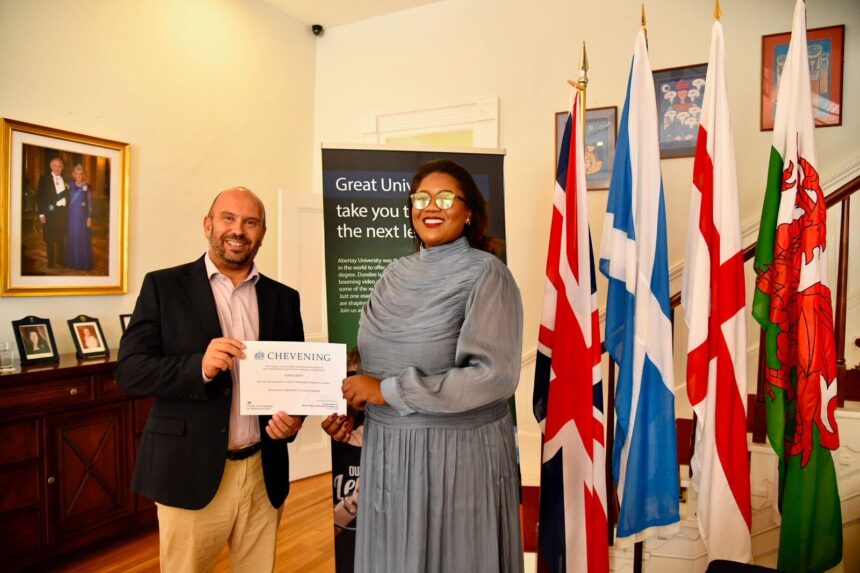
On Sunday, September 20, Bart leaves Saint Lucia for the United Kingdom as the country’s sole Chevening Scholar for the 2026/27 academic year. She will pursue postgraduate studies in architectural history at The Bartlett School of Architecture, University College London.
She found out she had won the Scholarship in a simple way. While checking her phone during lunch, she saw an email congratulating her.
“I remember putting the phone down and being like, this can’t be real,” she recalled.
Instead of celebrating immediately, she had to deal with the self-doubt that can sometimes accompany success.
“I think I had a bit of imposter syndrome because I had to go through the process of accepting that I have won this award fair and square and that I deserve it. Sometimes we work hard and we don’t accept when good things happen,” Bart said. “So, it was a good personal process for me as well.”
Bart is Saint Lucia’s only Chevening Scholar for the 2026/27 academic year, part of a group of just five scholars from the Eastern Caribbean.
She admitted that initially it left her feeling “very lonely”, particularly after being told how tough the competition was. But the Eastern Caribbean scholars, who study everything from medicine and media to logistics and architectural history, have already begun supporting each other.
“We’ve already made a promise to each other in Barbados that we’re going to stick together. So, I’m not too scared anymore.”
While Chevening is opening a new chapter for Bart, the passion taking her to London goes much further back.
“I always loved buildings, always loved spaces. And I remember saying I want to be the person that decides where things go,” she said.
She remembers the familiar childhood experience of watching the house get rearranged at Christmas and wanting a say in where everything should go. As she grew older, she discovered she could draw well, and that childhood instinct gradually found a profession.
While studying in Jamaica, Bart found herself increasingly drawn to her theory and history courses. That brought a deeper appreciation for culture and a concern that Caribbean people do not always recognise that the architecture in their own backyards is worth studying.
“We think of it as a big capital A of skyscrapers in Dubai and in the US,” she said. “But we’re not thinking about the bioclimatic approach that people have taken with getting houses. And having houses that fit the Caribbean context and the colours and our own cultural history with it.”
Four years ago, Bart started the Caribtecture Research Project to document and examine what Caribbean architecture is through written and visual work. Within that wider project is Luciantecture, which turns the lens specifically on Saint Lucia.
It means that when she looks at an old Saint Lucian building, she is interested in more than its appearance. She considers what influenced it, who built it, how people lived in and around it, and what could disappear if the country’s built environment changes without enough thought for what came before.
Among the features she fears could be lost are Saint Lucia’s French architectural influences, including traditional fretwork and stonework.
She noted that efforts have been made to pass on the skills required to maintain some of those features, but preservation also depends on whether a new generation of Saint Lucians actually wants them.
“But it’s also getting the public to buy in to want those things in their house. And want those things to be part of the environment. And not wanting to go straight to glass and nice fancy cladding,” Bart said.
She worries about what might replace that unique character as Saint Lucia modernises.
“That would be my biggest fear. Is that we start to look more like a first world country as opposed to the unique island that we are. And obviously that would impact our tourism and how we sell our product of who we are.”
But Bart’s interest in Saint Lucia’s built environment is not only about preserving the past.
Climate change poses a different and increasingly difficult question. Much of the island’s housing, buildings and livelihoods are concentrated along the coast. Bart thinks this means people must talk about sustainability, development and sometimes even moving communities.
For her, those decisions cannot simply be engineering or construction exercises. Moving a community means disrupting relationships, livelihoods and patterns of life that may have developed over generations.
“The social, political and economic aspect of architecture to me is often ignored,” she said. “And I think we don’t bring the public into that conversation as much as they should be a part of that conversation.”
The connection between buildings and people is a major reason why she chose Bartlett School. She explained that the programme examines rural and urban spaces through social, economic and political lenses, looking back at the forces that shaped them and considering what happens when they change.
She wants to use that knowledge to continue developing Caribtecture and Luciantecture, but does not envision doing it alone. She hopes to work with writers, artists and other architects to build a fuller record of the region’s architectural history.
Those plans are for the future. Right now, Bart is preparing to trade the familiar surroundings for a new city, new classrooms and an entirely new experience. When she leaves Saint Lucia on Sunday, she will enter a world that might change how she sees architecture, and maybe even how she sees home when she comes back.