By Stephen Fevrier
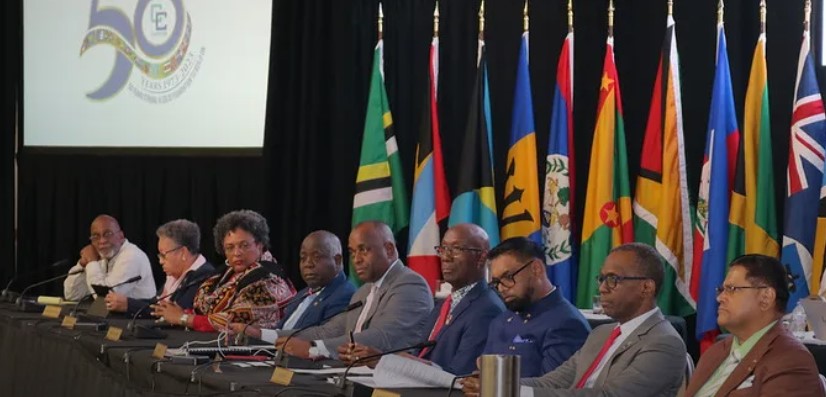
The ongoing spat between CARICOM (Caribbean Community) leaders – arising from differences over CARICOM’s relationship with Venezuela, the response to the recent security buildup involving US military forces in the Caribbean Sea, as well as partial US visa restrictions on nationals of Antigua and Barbuda and Dominica – signals a troubling deterioration of CARICOM cohesion.
The escalating war of words between Prime Minister Gaston Browne of Antigua and Barbuda and Prime Minister Kamla Persad-Bissessar of Trinidad and Tobago should not be taken in isolation from the wider stagnation of the regional integration process. It should be seen as a sobering moment, reflecting the reality that the region’s apex intergovernmental body has been struggling to live up to the expectations once placed in it. Uneven implementation, lack of coordination and growing perceptions of politically aligned governments meddling in elective politics have progressively undermined confidence in the CARICOM project.
CARICOM was established by the Treaty of Chaguaramas, which entered into force on August 1, 1973. Its core purpose was to integrate economic efforts, coordinate foreign policy and deepen functional cooperation across determined sectors. At its heart was the ambition of newly independent states to collectively shape a common post-colonial future. The Caribbean Community thus emerged as an institutional bridge between colonial fragmentation and collective self-determination.
The community built on earlier integration efforts, notably CARIFTA (1968) and the West Indies Federation (1958–1962). While the Federation sought a single political state, the Treaty of Chaguaramas deliberately chose a more cautious path, namely functional cooperation without political union. CARICOM preserved national sovereignty while attempting to coordinate policy and leverage collective strength. It was, in effect, a compromise between independence and federation.
Over time, that compromise has revealed its limits. Since the Grand Anse Declaration of 1989, which launched the agenda towards the CARICOM Single Market and Economy (CSME), progress has been uneven and frequently stalled. Implementation of signed protocols has been inconsistent, and the promise of a genuine single market remains only partially fulfilled.
Today, fragmentation within the CSME persists, evidenced by existing restrictions on labour mobility and non-tariff barriers, as well as divergent immigration and customs rules.
But concerns about CARICOM’s effectiveness are not new. As far back as 1992, the West Indian Commission produced a seminal report, A Time for Action, which bemoaned fragmentation as a structural weakness. It also noted the underperforming integration model, the entrenchment of an implementation gap and increasing economic vulnerability. While the report set in motion actions that led to the establishment of the Revised Treaty and the CSME, many of the challenges highlighted by the Commission in 1992 persist today.
Later on, in July 2010, Heads of Government commissioned a review of the CARICOM Secretariat and its functioning. The findings were tabled in 2012 and identified many of the same structural and governance challenges that continue to plague the Community.
Yet meaningful action did not follow.
Frustration with this inertia later prompted Jamaica to undertake, under the chairmanship of former Prime Minister Bruce Golding, a review of its relationship with CARICOM and CARIFORUM. The Golding Report captured concerns widely shared across the region: weak compliance with Community decisions, persistent implementation failures within the CSME, and a growing sense that CARICOM’s intergovernmental model lacked the authority necessary to enforce its own rules.
The Golding Report argued for deeper structural reforms, stronger enforcement mechanisms, more efficient decision-making, and clearer institutional processes. While the report circulated informally among CARICOM Heads, it was never formally adopted or acted upon by CARICOM as an institution.
Since then, perceptions of imbalance within the community have intensified. Many now see an uneven distribution of benefits between Trinidad and Tobago on the one hand and the OECS on the other. Development gaps are also widening between resource-rich Guyana and structurally constrained CARICOM Less Developed Countries (LDCs). Persistent resource limitations at the Secretariat and deepening policy coordination gaps have contributed to further erosion of trust.
Within the OECS, similar concerns have emerged regarding the adequacy of regional adjustment mechanisms (such as the Caribbean Development Fund) and the capacity of existing arrangements to ensure equitable outcomes from integration. Allegations of cross-border political involvement, whether justified or not, also carry serious risks for regional cohesion. These pressures have increasingly spilt into the open. Political alignments among like-minded governments are now becoming harder to ignore. This is evidenced by the participation of selected CARICOM Heads at the recent swearing-in ceremonies of Prime Minister Godwin Friday of Saint Vincent and the Grenadines and Prime Minister Philip J. Pierre of Saint Lucia.
Similar challenges have confronted other integration projects. During the global financial crisis and the early stages of the war in Ukraine, the European Union grappled with internal divisions driven by uneven development, weak coordination and energy insecurity. In response, the European Commission tasked former European Central Bank President Mario Draghi to conduct an assessment of the structural constraints that undermine European competitiveness and lay out recommendations on how Europe can boost its economic growth.
It is time CARICOM embarks on a similarly candid independent assessment. One that confronts the structural weaknesses of the regional project and tailors reforms to fit current realities.
For CARICOM to succeed, there must be a clear path forward. While past reviews – including the 2012 Secretariat review and the Golding Report – should be taken into account, a new comprehensive evaluation of competitiveness, governance, and equity within the Community is now required.
Equally important is a recommitment to mutual respect, non-interference and trust among CARICOM Heads.
Let us heed the lessons of the failed Federation. As Dr. Eric Williams once warned, one from ten leaves nought.
Amb. Stephen Fevrier is a former OECS Ambassador to the United Nations in Geneva and a former Senior Advisor to the Director-General of the World Trade Organisation. He holds a Bachelor’s degree in Political Science, a Bachelor of Laws, and a Master’s degree in International Commercial Law.